I am beginning to work my way through a leadership & counseling series done by Paul David Tripp (visit his blog), along with some other students here at the Bible Institute. One thing he said that I highlighted in my mind was about truth. He said something along the lines of "truth to each person is not based on facts, but is based on their interpretation of the facts". I think he got it right....look how many viewpoints claim they know the truth? We all have the same facts...
The same is true when interpreting the Bible. It bugs me when I hear someone "exposit" scripture...then come up with some profound meaning hardly found within the text. The Bible is not a mysterious book full of allegories, hidden meanings, and secret truths. It is a book with a simple clear truth. I am convinced that we can interpret the bible literally taking into consideration the grammar & context. I think most "conservative" evangelicals would agree. But I also see many "conservatives" suddently take a slightly different approach when looking at Song of Solomon. Is it Christ & the Church? Marriage counselling? A graphic story? Michael Spencer @ internetmonk.com wrote an awesome article on this. See it here.

You can see the above and a few more on my flickr acount.
I made a more complete album with the last leg of our Brazil trip (the part in Rio) on facebook. You can check the album out here.


It irks me, really irks me, when I hear someone explaining how to get saved, but they forget crucial parts of the Gospel, or the explanation is confusing.
So often I hear "Believe that Jesus died on the cross and you will be saved" or "Ask Jesus into your heart", or believe.
Asking Jesus into your heart is a concept not found in the Bible. Dennis M Rosker, pastor of Duluth Bible Church in Duluth, Minnesota wrote a great article on this topic:
7 Reasons NOT to ask Jesus into your Heart.
But what about "Believe Jesus did on the cross and you will be saved" ?
Yes Jesus did die on a cross, and you must believe that, however this is not the whole Gospel.
The Gospel is simple: I deserve eternal death because I sin (Rom. 3:23) and it has to be paid for (Rom. 6:23). In my place Jesus Christ paid for my sin and even though he was God, allowed himself to die on a cross (Rom 5:8) as a man in my place. He took the penalty and shame for every sin I committed instead of me. He spent three days in the grave, then rose from the grave alive (Rom. 6:9), conquering sin and proving He was God. He then ascended into Heaven where he sits at the right hand of His Father where he says to the father: See Jonathan, he is perfect. He has no sin. His sin is paid for. All of it. (Rom. 8:1) Because of that I can have fellowship with God, I am perfect before God.
How is one saved? Just believe it. Have faith that Christ did it all, and acknowledge that we are helpless on our own, and deserve what he paid for!
Romans 5:1, 1 Corinthians 15:1-4
Often times people (even evangelicals who believe in grace & no works) forget the simple concept of substitutionary atonement, meaning Christ took my place to pay for my sins, to make peace with God.
When preaching the Gospel, Preach the full Gospel.
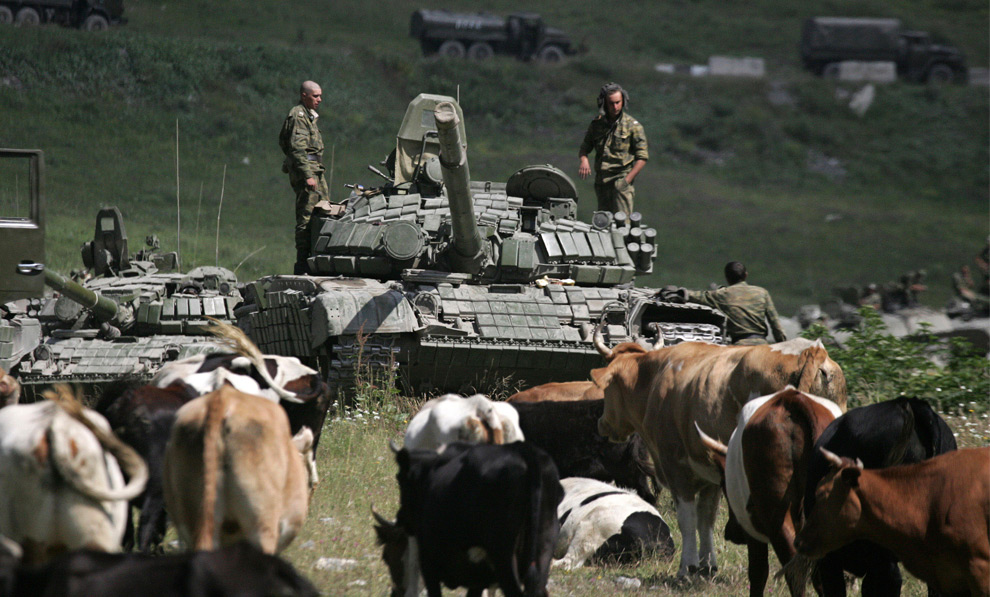
A few days ago Russia began moving troops into Georgia. According to Russian officials, over 2000 civilians have been killed in conflict, and Georgia has declared a state of war in South Ossentia. Georgia claims it as part of their country, while Moscow claims the area is independent of Georgia.
In the midst of the conflict, photographers and reporters risk their lives to get the story out. See some of their photos here:
http://www.boston.com/bigpicture/2008/08/war_in_south_ossetia.html
Today 80% of the Georgia's population of 4.6 million practices the teachings of the Eastern Orthodox Church. The Eastern Orthodox Church is the second largest "Christian" communion after Catholicism. The Orthodox Church would adhere to several orthodox (orthodox as in essential doctrines adhered by all "Christians") Christian doctrines such as the Trinity, the death, burial, and resurrection of Christ, the Bible as the rule of faith (as do Catholics and Protestants). However the Orthodox Christian, like a Catholic, relies on a faith+works salvation. Their worship is very traditional and full of symbols, chants, readings, and rituals, and this has introduced many heresies in the church over the ages.
Well our trip to Brasil is over halfway done and I still haven't posted an update on the blog! We had no flight troubles through our connections and ended up landing in Goiania. Some friends picked us up and took us to Anapolis (300,000) . We spent a night there before catching a bus 8 hours North into the state of Tocantins, where we stayed with friends. They have a Chacara (small farm) about 10k outside of Formoso do Araguaia. While there we helped them with some projects they had going on (ie. building a Chapeu de Palha). The house they were living in was still under construction so it had no electricity and only was partially covered with a roof. We had an  awesome time hearing of God's faithfulness to them and their huge family, and even got to visit two Villages on Bananal Island (Worlds largest freshwater island).
After spending a week with them we returned to Anapolis for a few days where my sister had 4 wisdom teeth removed. After a couple recovery days, we headed to a small town an hour from Anapolis where *** has a school and language training program. That is where we are right now. I helped out putting a new roof on part of the high school, and my sister & Cherie helped painting and cleaning.
We were able to do some fun stuff throughout our stay as well. (climbing waterfalls, swimming, hiking, exploring a cave etc..).
Tuesday we head to Rio before flying home on the 18th of July. Thank you all for your prayers & support!
Many people would say they love God's Word, and many do read it everyday, but start talking about digging into scriptural doctrine & theology they shy away from it. Excuses: Theology divides, we need to focus on what unifies, theology puffs up as long as you believe Christ died & rose again etc...and the list goes on. And many of those points are valid (Theology does divide, and it can make one proud!). But I think that anyone who seriously claims they love His Word, must seriously spend time studying it and trying to understand it and the true doctrine contained within it's pages. If one's heart has a passion for Christ one it must also have a passion for accurate doctrine.
Theology is the study of God. God has revealed Himself in two ways: Generally (through nature/creation), and specifically (through His Word the Bible). Theology generally focuses on his specific revelation, the Bible as it specifically reveals to us information about Him, and His plan for mankind, which ultimately is to glorify Himself.
I like theology...
I really enjoy learning about God through His written Word, and studying it to find out more about Him, and the nature of His saving grace! Therefore I really enjoy studying His Word and the doctrine contained within it, because the more I learn about Him, the more I learn about myself and how undeserving I am of what He did for me.
Importance of Theology
I believe that it is important for every believer to study God's Word and know & speak sound doctrine (Titus 2:1) and be able to quickly identify false teaching. (2 Cor. 11:1-4, 13-15).
I believe it is important to be able to not only give a reason of the hope that lives in you, but be able to give a defense of it (1 Peter 3:15, Phil 1:7, Titus 1:9).
I believe it is important to accurately apply scripture, and accurately challenge & teach others (2 Tim 2:2, 2:15, 4:2)
It enables me to analyze my heart's spiritual emotions and personal experiences and see if they are based on truth. (Jer. 17:9)
so that I might glorify God in every area of my life.
Essential vs. Non-essential
I love learning about all different aspects & viewpoints of doctrine and theology, however it is true that some doctrines are essential (ie. Diety of Christ, depravity of man, salvation by grace through faith, etc...) and some are less essential, or non-essentials (Are the Nephelim an evil race of man-angel children? Were we physically present with Adam when he sinned, or did he represent man in the "original sin"?).
The ratio of essentials to non-essentials varies in all denominations, from the Fundamentalists, some of whom place most doctrines as absolutely essential, and take a stand on everything, to the Emergents who loosely hold to a few core doctrines, but let all else slide since "who can know truth?"...and even as far as the Liberals who hold to virtually nothing.
The core-doctrines essential to Christianity are known as "orthodox truths" and are held to by the majority of denominations.
Sound Doctrine divides, it always will. It is my goal through studying God's Word to glorify Him, and therefore divide on certain issues relation to God's holiness, scriptural reliability, salvation, and following commands found in His Word.
Read this great article looking at the relationship between Fundamentalism & Liberalism.
Sincere Godly Christians, Different Viewpoints
So how can I come to a conclusion on true doctrine within the Bible when there are so many "godly" christians who have very different opinions on different doctrines (ie election, women 
Well it all starts at how you interpret scripture. Therefore the foundation to studying Theology is your hermeneutics, your method of interpreting scripture, so that you may properly exegete, or "get out" an interpretation of the text.
Therefore foundational in your study of Theology is Bibliology, or the study of the bible, and consequently your hermeneutics. How you interpret the Bible will lead to you settling on different conclusions on doctrines.
Personal Note: I really like discussing theology, different viewpoints, and ideas, but on non-essential issues I really don't want to argue! I may have an opinion on certain non-essential issues, and enjoy discussing them, but they are NON-essential! I discussing non-essential things can be healthy and fun, but it should not divide.
I believe we should divide on essential and important truths, but that being said I fully acknowledge that many people I believe to be seriously inaccurate in their interpretation of scripture are just as much saved as I am! What is scary is that people who may be accurate in their interpretation of scripture have missed the application and may not be saved at all!
I simply pray that all I do & say will glorify my Father in heaven.

 RSS Subscribe